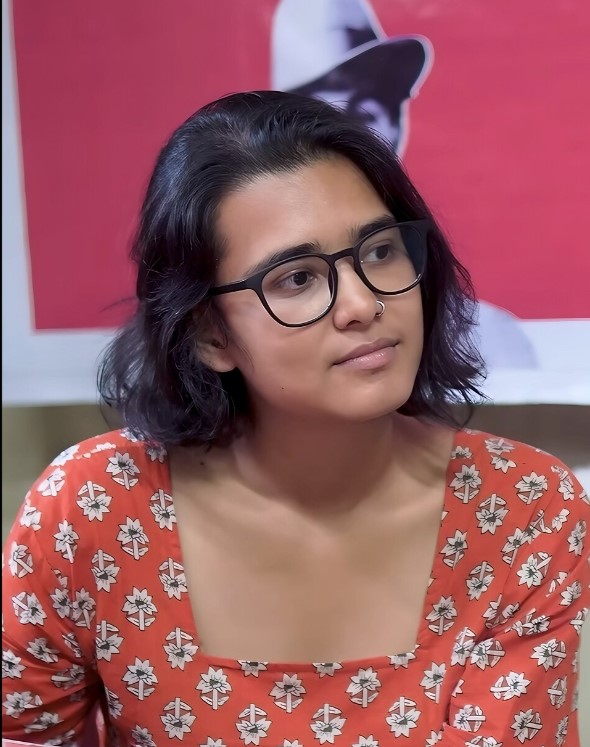
The Indian student leader who undertook a 23-day hunger strike during the recent Delhi student protests speaks about exam leaks, youth unemployment, the Cockroach Janata Party and the Left’s attempt to reclaim political space among India’s young and restless
Neha Bora, who has emerged as one of the prominent faces of India’s Leftist student movement following the recent student protests held in the national capital, Delhi, under the leadership of the newly formed Cockroach Janata Party (CJP), has been travelling across India since the Modi government agreed to the demands of the protesters, which included the resignation of the Union Education Minister.
Bora, the National President of the All-India Students’ Association (AISA), which is affiliated with the Communist Party of India (Marxist-Leninist) Liberation, had staged a 23-day hunger strike along with engineer-activist Sonam Wangchuk, in solidarity with CJP, which was formed in response to the Chief Justice of the Supreme Court of India, Surya Kant, referring to unemployed young people in India as cockroaches and parasites. Sensing a political opportunity, US-based Abhijeet Dipke, a 30-year-old millennial student at Boston University, launched CJP and flew back to India, demanding the resignation of Education Minister Dharmendra Pradhan over a series of exam leaks and irregularities in the marking system. Leftist student unions such as the Students’ Federation of India (SFI), All India Students’ Federation (AISF) and AISA pledged support to the CJP’s agitation. SFI is the student arm of the Communist Party of India (Marxist), or CPM, and AISF that of the Communist Party of India, or CPI. With Bora, Aishe Ghosh of the SFI and others joining the protests, the Left parties were able to exercise their influence far disproportionate to their electoral strength, which has dwindled drastically over the decade. Bora, an alumna of India’s prestigious Jawaharlal Nehru University, where she is a PhD student, had earned her BA from Delhi University and MA from Ambedkar University. During the hunger strike, she lost around 7.5 kg. Education Minister Dharmendra Pradhan finally resigned on July 25, marking a major victory for the protesters.
The Indian student leader speaks about the brutal police crackdown by Indian forces on peaceful protesters on 20 July, a popular front against the ruling Bharatiya Janata Party (BJP), growing up in an army family where her father had a transferable job, leaks and irregularities in competitive exams in India such as the National Eligibility-cum-Entrance Test-Undergraduate (NEET-UG) for medical students; the University Grants Commission (UGC), the statutory body which provides recognition to universities; the Staff Selection Commission (SSC) that conducts exams for various central government jobs; the UGC-National Eligibility Test (NET), which determines eligibility for certain academic positions; state-level Provincial Civil Services (PCS); and so on. Edited excerpts from an interview:
What are your principal areas of convergence with the other non-BJP parties and student formations and where do the key differences lie? When you are part of a broader popular front, how do you navigate these ideological and political contradictions?
Our principal point of convergence with non-BJP parties and student formations is the recognition that the BJP has systematically hollowed out India’s democratic institutions. Institutions such as the Election Commission, the media, and other constitutional bodies increasingly function as extensions of the ruling regime today, that is BJP-RSS. The Special Intensive Revision, or SIR, is a recent example of how the electoral process itself is being used to exclude sections of citizens, particularly Muslims, Dalits, and other marginalised communities, from political participation, literally making them second-class citizens in their own country.
In this situation, every mass movement that pushes back against the BJP creates the possibility of a broader popular front. We have seen this in the historic farmers’ movement, in struggles for social justice, in the movement for UGC Equity Regulations, and now in the growing countrywide struggle around education and examinations.
The key difference is in how we understand the regime and the task before us. While some parties may see the BJP primarily as an authoritarian government that needs to be removed electorally, we understand the BJP RSS regime as a Hindutva fascist formation, against which electoral intervention alone is not sufficient. For us, this requires building sustained people’s movements from below. Ideological differences within a broader front are inevitable. Different political forces come with different orientations and objectives. But these contradictions can be navigated through a common minimum programme and a clear understanding of the immediate task, which is to push back the Hindutva fascist regime and defend democracy, constitutional rights and people’s struggles. Within such a broad front, AISA will continue to bring its own independent politics, organisation and strength to the struggle.
You come from an Army family, a background often associated with aggressive nationalism and, in recent years, pro-Modi political leanings. What experiences made you depart from that worldview and arrive at a position that is so sharply and diagonally opposed to the BJP, both ideologically and politically?
I think there is a perception that is being created of the Army being pro-BJP or favourable to its politics. However, my own experiences say this is the political perception that BJP wants to make. They want to militarise their political thought in the public and among the armed forces. But this is the ground reality. My association with left politics came from the inequalities, injustices and troubles I saw of students and working class in the economy. It was an eye opener. Those who pay the taxes are responsible for the salaries and running the country including the defence forces are suffering from the policies of the government. This was an eye opener for me. How the We the People of India are suffering and there is silence on their trauma. This made me come closer to what I do. Let me tell a small story. On my way to Kolkata I met a few former Army officers. They not only stopped to say hi, but sat with me, appreciated what I did and treated me with coffee. This is not one isolated instance. Shows the kind of acceptance of our politics.
Some argue that the NEET-UG exam leak primarily affected a relatively privileged section of students and did not address the broader crisis in education, including the closure of government schools, chronic underfunding of public universities and medical colleges and unequal access to quality education. Do you think the movement’s relatively limited demands–such as the Education Minister’s resignation and compensation for students who took their own lives over the leaks–along with its largely middle-class social base, paradoxically made it more focused and therefore more successful?
It is true that the movement began with the NEET-UG paper leak, but it soon developed into a much broader movement against the examination and recruitment crisis in India. Students and aspirants preparing for SSC, UGC NET, PCS and various other government examinations joined because they recognised a common experience of paper leaks, cancellations, irregularities and an absence of accountability. What emerged was the accumulated anger and despair of lakhs and crores of young people who have faced this crisis for years. The movement also began opening up broader questions around education. We saw students, including school students in places like Jharkhand, beginning to raise questions about basic facilities and the conditions of their schools. That is an important transformation. The movement gave young people the confidence that collective struggle can actually force the government to respond and that change is possible.
The immediate demands, such as resignation of then Education Minister Dharmendra Pradhan, were certainly more limited than the structural demands that AISA has been raising. Since the introduction of the New Education Policy (NEP) in 2020, AISA has consistently opposed the National Testing Agency (NTA) and demanded its scrapping because of its repeated failures to conduct credible examinations. But the NEET movement created an organic mass mobilisation around these issues and its clear immediate demands gave it a sharp political focus. So yes, the movement succeeded in winning a certain degree of political momentum precisely because it had a clear and immediate point of intervention. But its significance goes beyond those immediate demands. It has opened the possibility of a much broader struggle for a publicly funded, accessible and accountable education system and for a structural transformation of the examination and recruitment system.
What are your thoughts on the kind of policing witnessed during the student protests in Delhi? Do you see parallels with the increasingly militarised response to student movements elsewhere, particularly in the United States, where police have used heavy-handed tactics against students protesting Israel’s war in Gaza? Is policing in India acquiring a similar character of institutionalised brutality (similar to ICE)?
The militarised policing we are witnessing in India has to be understood as part of the broader authoritarian and fascist character of the present regime. Modi takes political inspiration from figures such as Trump and Netanyahu, and we can see similar patterns in the way governments across the world respond to popular resistance.
In India, institutions meant to perform civil responsibilities, including the police, have increasingly been weaponized to serve the interests of the ruling BJP government. The voices of dissent are routinely framed as anti-national, and the objective is no longer simply to disperse a protest, leave alone having a dialogue with them. There is an increasingly deliberate attempt to assault, intimidate and punish protesters, to teach them a lesson for raising their voices.
The brutality witnessed in Delhi on 20 July might be shocking for the people observing the movement from a distance, but it is not something new or an isolated phenomenon under the Modi regime in India. Those who have followed the repression of student and democratic movements over the last decade, including the struggles around citizenship and other mass movements, will recognise a pattern. Tear gas, physical assaults, pellet guns and, in Bihar, even automatic rifles have been used against students and ordinary citizens demanding accountability. This is why I would describe the brutality as increasingly institutionalised. There are certainly common characteristics in the way far right and authoritarian governments learn from one another in suppressing popular movements. But there is also another historical lesson. Whenever people have organised collectively against authoritarian and fascist forces, they have ultimately challenged and defeated them. That is the confidence with which we approach these struggles today.

