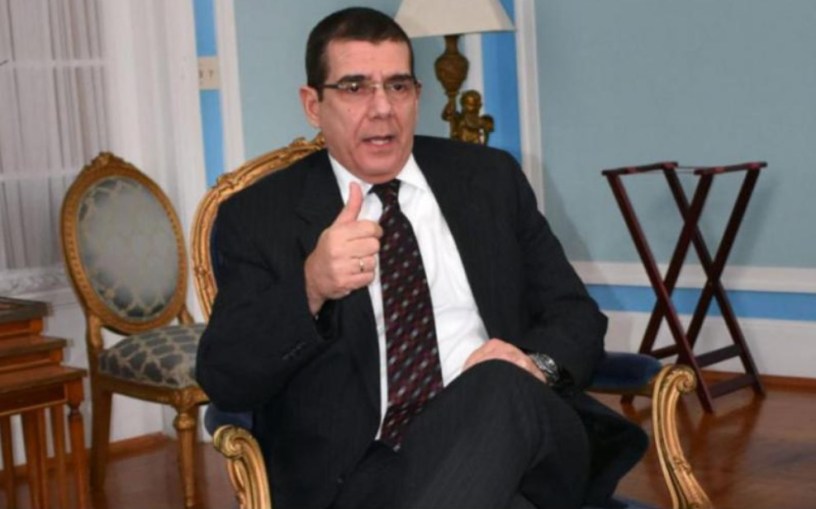
In response to Donald Trump asking Cuba to make a deal with him or face the consequences, and about the American President endorsing a post on social media suggesting his Secretary of State Marco Rubio, born to Cuban immigrants, as the next ruler of Cuba, a legendary Cuban diplomat says, “We don’t eat fear.”
Trump posted on his Truth Social account on January 11, “Cuba lived, for many years, on large amounts of OIL and MONEY from Venezuela. In return, Cuba provided “Security Services” for the last two Venezuelan dictators, BUT NOT ANYMORE! Most of those Cubans are DEAD from last weeks’ U.S.A. attack, and Venezuela doesn’t need protection anymore from the thugs and extortionists who held them hostage for so many years. Venezuela now has the United States of America, the most powerful military in the World (by far!), to protect them, and protect them we will. THERE WILL BE NO MORE OIL OR MONEY GOING TO CUBA – ZERO! I strongly suggest they make a deal, BEFORE IT IS TOO LATE. Thank you for your attention to this matter.”
Dr C Jose Ramon Cabanas Rodrigues, former Cuban Ambassador to the United States, tells Open: “They have been trying to do that for over 67 years. We had (the) Bay of Pigs (attack), 648 attempts to kill Fidel (Castro), a blatant economic-financial blockade. We have overcome all those tests. What is different now? In Cuba we have a saying to summarise this: we don’t eat fear.”
In 2015, Dr Cabanas Rodrigues became the first Cuban ambassador to the US in 54 years, a post that had lain vacant for more than half a century. Previously, he was the chief of the Cuban Interests Section in Washington D.C. He continued to remain ambassador until 21 December 2020 during the time of the US-Cuban thaw and the worsening of it during Trump’s first term. When he was ambassador to the US, the two countries saw a massive shift in relations. In 2016, President Barack Obama visited Cuba, the first such event since 1928.
Meanwhile, although Marco Rubio is a son of Cuban immigrants, the story he had earlier peddled – that his family had fled communism in Cuba – was proven to be wrong. Marco Rubio’s misrepresentation was exposed by most newspapers, including The Washington Post, which stated that his parents left the island nation for the US before Castro came to power in 1959. Rubio, who used the anti-Castro narrative to promote his political career, had also campaigned in 2010 stating that, “As the son of exiles, I understand what it means to lose the gift of freedom.” According to The Post report that called him out, Rubio’s parents had left Cuba in 1956 during Batista’s period for economic reasons.
After his lie was unearthed, Rubio’s resume only says that “Marco Rubio was born in 1971 in Miami, Florida, as the son of two Cuban immigrants pursuing the American Dream”.
In fact, Rubio is often denounced as “Narco” Rubio by his detractors because of his brother-in-law Orlando Cicilia’s role in drug trafficking. A recent report by Naomi Feinstein in Miami New Times said, “When Rubio was 16, Cicilia, who is married to Rubio’s older sister Barbara, was arrested on federal drug charges for dealing cocaine. After Cicilia immigrated to Miami in 1972 when he was 15, he met Barbara in high school, and the pair started dating. Barbara ended up staying in Miami with Cicilia when Rubio’s father got a bartending gig in Las Vegas in 1979.”
It added, “The Rubio family decided to move back to Miami two years later and temporarily lived at Cicilia’s home in West Kendall. The family, including 14-year-old Rubio, lived at the house around June 1985 until July 4. At that point, his brother-in-law played a significant role in the $75 million drug operation, right out of his home.”
According to reports in the US media, Rubio had repeatedly avoided queries about his ties with his brother-in-law, who, however, since his release from prison, had often shared the stage with Rubio during campaign rallies.
Cuba, which offers all its citizens free education and healthcare, has been under American sanctions since the early 1960s. After the fall of the Soviet Union, which was the country’s major trade partner for decades, the Caribbean nation has faced international isolation thanks to various new US legislations aimed at regime change. Despite facing an acute shortage of raw material, food products and other essential items for its 10 million citizens, which is partly responsible for the exodus of its educated young people, Cuba stands out on the world stage for its cutting-edge biotechnology and medical research.
 Ullekh NP