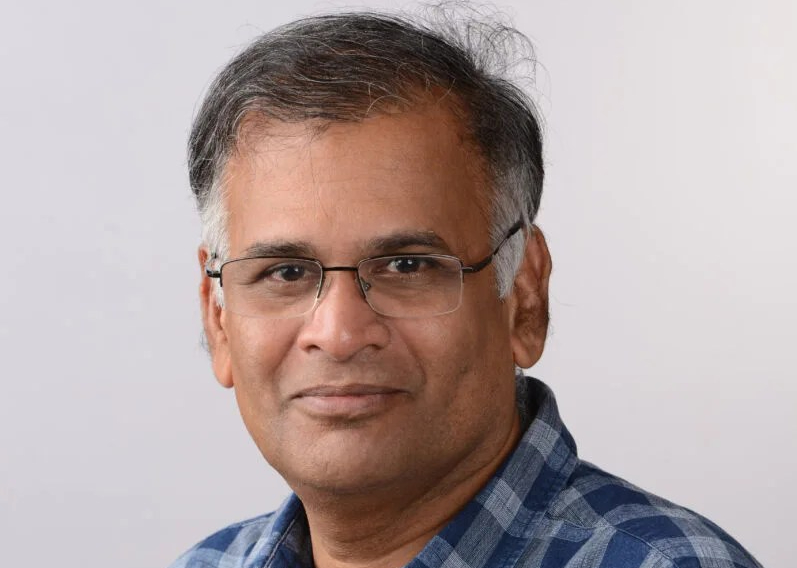

B. Jeyamohan
Valorizing drinking and drug use must end, says the bilingual author and screenwriter
By Ullekh NP
“Someone had to say this,” asserts writer B Jeyamohan regarding his full-throated condemnation of the Malayalam movie Manjummel Boys, which he claims legitimizes and normalizes drinking, drug addiction, and other indulgences, even in the verdant hills and dense forests of South India where liquor is banned. He also launched a blistering attack on Malayali tourists for their self-destructive tendencies and reckless revelry while on holiday. Jeyamohan also alleged that a powerful gang of Kochi-based film directors and producers—most of whom, he claimed, are linked to drug money—celebrate vulgar behavior and other excesses in their films.
His strongly worded blog post attracted backlash in Kerala, where filmmakers, writers, critics, and even a section of politicians berated Jeyamohan for making what they said was a sweeping statement reflecting the language used by the Sangh and Keralaphobics to criticize the state. They also denied that Kochi-based filmmakers are associated with any drug mafia.
In a phone interview with me, Jeyamohan, the widely read Malayali-origin Tamil novelist, essayist, public intellectual and screenwriter, said he is being defamed by a section of scholars and cultural figures for his unwavering stand against not only the Hindutva forces but also linguistic fundamentalists in Tamil Nadu, apart from their apologists in Kerala who can’t handle the truth—about movies that valorize alcoholism and drug use.
When questioned whether his comments and choice of words to describe Malayalis, especially male-only holidaymakers from the state, were excessive, he said he didn’t speak like a critic but as a writer who used aggressive and somewhat “emotional” language to spotlight a growing menace. He said he wrote about a phenomenon that cultural figures in Kerala refused to discuss, leading to a sense of repulsion. “Writers I was close to, such as PK Balakrishnan, M Govindan, Sundara Ramasami, Jayakanthan, and others, often used sharp generalizations as a technique to draw public attention to issues that were always swept under the carpet,” he reasoned. Jeyamohan, 61, added that a writer is not someone who gives survey reports but impressions. “Only such statements are effective,” he noted, citing that he was proved right when he said close to two years ago that Dalit students were easy victims of caste supremacists in Tamil Nadu’s government schools. “Immediately, there was a hue and cry. But when there was a murderous attack shortly afterward on a Dalit student and his sister in Nanguneri, Tirunelveli district, even the state education minister had to step in and make a similar statement as I had made, decrying caste animosities in rural Tamil Nadu and schools.”
In Tamil Nadu, wealthy children attend private schools and the poor attend government schools, which have become dens of casteism and rowdyism, Jeyamohan had said, drawing the wrath of Dravidian parties in the state.
Jeyamohan, who is also an expert on Tamil and Indian philosophical traditions, said his detractors who write books and articles portraying him as a pro-Hindutva author are mostly those who owe allegiance to the ruling DMK, who, according to him, are irked the most because he criticizes the linguistic fascism of ‘Periyar’—also known as EV Ramasamy Naiker—who is considered the father of the Dravidian movement.
He claims he is specifically targeted by pro-Dravidian propagandists for exposing lies taught in Tamil Nadu’s school textbooks about Periyar. “Textbooks claim Periyar launched and consummated the Vaikom temple entry agitation (in 1920s Travancore), with no mention of major players in the iconic struggle such as TK Madhavan, or the support it received from Sree Narayana Guru and Mahatma Gandhi. I have exposed this lie in my articles. All this criticism against me started since then,” argues Jeyamohan, whose stellar works such as Vishnupuram and Venmurasu (the world’s longest novel ever written) delve into serious debates in ancient Indian philosophies and the Mahabharata. His famous works in Malayalam include Nooru Simhasanangal and Aana Doctor. Jeyamohan had said in his interviews that he was briefly associated with the RSS (the Sangh) in his youth before he snapped ties with the right-wing Hindu organisation over differences of opinion.
Jeyamohan, the bilingual novelist and literary critic with a cult following in the Tamil-speaking world, states he has written more than 300 essays and articles criticizing the Hindutva ideology. “They still want to project me as a Sangh loyalist. Like historian Ramchandra Guha, I am one of those who has consistently attacked Hindutva forces and their insidious ways,” says the author.
He opined that he was singled out for character assassination by “Tamil fundamentalists” also because he had rebuked efforts by vested interests to project that archaeological excavations at Keezhadi in Sivaganga district of Tamil Nadu make the southern region the most ancient civilization in India. Carbon dating of charcoal proved that the Keezhadi settlement was around 2600 years old. “But the Indus Valley and various other ancient settlements are much older,” Jeyamohan said.
Returning to his remarks on the drug mafia in Kochi and its nexus with the Malayalam film industry, he hopes that more people will start talking about it very soon. “I faced huge retaliation because I was the first to say it forcefully. Now, people won’t hesitate to state the obvious. It is natural for the person who says it first to bear the brunt,” says the author who last year backed DMK leader Udayanidhi Stalin over the latter’s attack on Sanatana Dharma. “I agree with what Udayanidhi Stalin said because Sanatana Dharma in the South is associated with the Vedic tradition, which has for many centuries been opposed by Tamil Shaivites as well as others, including nastika, Jain, and Buddhist traditions that dominated the South for centuries until the Bhakti movement happened,” he had said, throwing his weight behind a political entity he has often sharply criticized.
Jeyamohan said he is currently working on a novel based on Sudalai Madan, a character from Tamil folk tradition.
 Ullekh NP